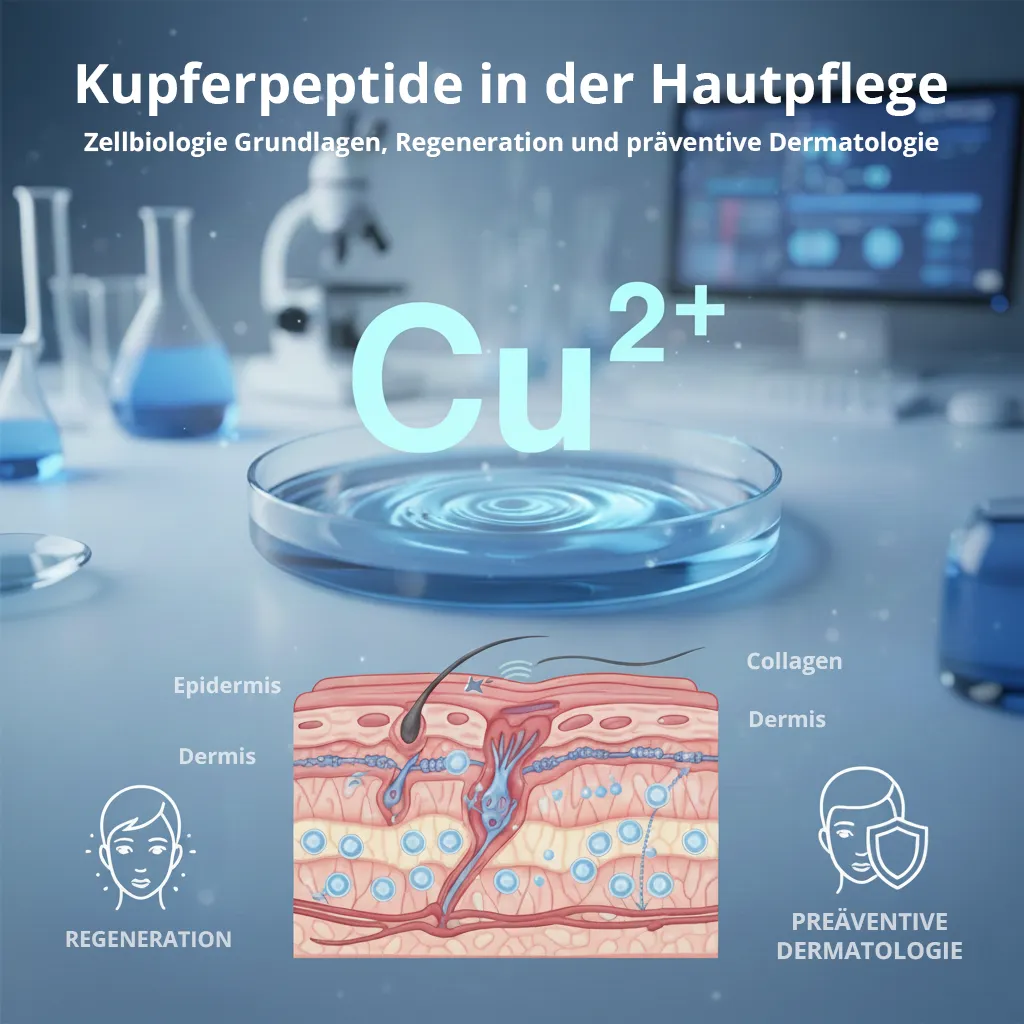
Cell-biological basics, regeneration and preventive dermatology
1. Skin ageing as a biological process
The skin is a complex, metabolically active organ. Its ageing is not a purely cosmetic phenomenon but the result of profound biological changes: slower cell division, reduced collagen production, increasing oxidative stress and chronic low-grade inflammatory processes ("inflammaging").
In modern preventive medicine, skin ageing is therefore understood as part of systemic ageing mechanisms – visible in an organ whose structure and function are closely linked to overall health. In this context, substances such as copper peptides are increasingly coming into focus.
2. Definition: what are copper peptides?
Copper peptides are short amino acid sequences that bind a divalent copper ion (Cu²⁺). The best-known and most extensively studied molecule is GHK-Cu (glycyl-L-histidyl-L-lysine copper).
GHK is an endogenous tripeptide found in blood plasma and interstitial tissue. Its concentration declines measurably with age. Copper, in turn, is an essential trace element and a component of numerous enzyme systems required for tissue formation and cell regulation.
3. Cell-biological mechanisms of action
3.1 Influence on skin cells
Copper peptides act primarily at the cellular level. In experimental models, they have been observed to influence, among others:
- Fibroblasts, which are responsible for synthesising collagen, elastin and proteoglycans
- Keratinocytes, which maintain the epidermal barrier
- Endothelial cells, which are involved in microcirculation
Effects on cell migration, cell survival and the regulation of reparative processes have been described.
3.2 Extracellular matrix and structural stability
The extracellular matrix (ECM) forms the structural framework of the dermis. With age, the balance between the build-up and breakdown of this matrix shifts in favour of degrading enzymes, particularly matrix metalloproteinases.
In preclinical studies, copper peptides have been observed both to promote collagen synthesis and to modulate excessive breakdown of the ECM. They thus act not primarily on the surface but on the structural foundations of the skin.
4. Antioxidant and inflammation-modulating properties
Oxidative stress is considered a central driver of extrinsic and intrinsic skin ageing. In studies, copper peptides were associated with increased activity of antioxidant enzymes such as superoxide dismutase, which neutralise free oxygen radicals.
In parallel, a regulating influence on inflammatory signalling pathways has been observed. This combination is relevant because chronic, subclinical inflammation contributes significantly to premature skin ageing without being immediately clinically visible.
5. Clinical relevance and state of evidence
The scientific evidence on copper peptides can be assessed in a differentiated way:
- Preclinical studies provide robust indications of regenerative effects and effects on inflammatory processes.
- Smaller clinical investigations report changes in skin elasticity, skin density and fine lines with topical application.
- However, there is a lack of large, independent long-term studies that would clearly establish copper peptides as a clinical gold standard.
From a dermatological perspective, copper peptides are therefore regarded as plausibly effective, well tolerated and complementary, not as a substitute for established medical approaches.
6. Place in a preventive skincare routine
Copper peptides are particularly useful as part of long-term skincare concepts. They can easily be combined with:
- consistent UV protection
- barrier-stabilising lipids
- antioxidant companion ingredients
What matters is less the maximum concentration of the active ingredient than continuous, well-tolerated use.
7. Safety and responsible use
When applied topically in cosmetic formulations, copper peptides are considered safe. Nevertheless, restraint is advisable:
- overdosing offers no proven additional benefit
- unstable or improperly formulated products can lose their effectiveness
- individual skin reactions should be taken into account
Well-informed use is clearly preferable to experimentation.
Conclusion: preserving structure instead of masking symptoms
Copper peptides represent a rational approach in skincare: they are not aimed at short-term effects but at preserving biological structures and functions.
In the context of preventive dermatology, they are being researched in connection with age-related changes in the skin and its regenerative capacity. They are therefore in focus less as a fashionable ingredient than as a biologically grounded addition to health-oriented skincare – with the aim of maintaining skin function, resilience and quality of life over the long term.